





Eye For Film >> Movies >> We Are Aliens (2026) Film Review


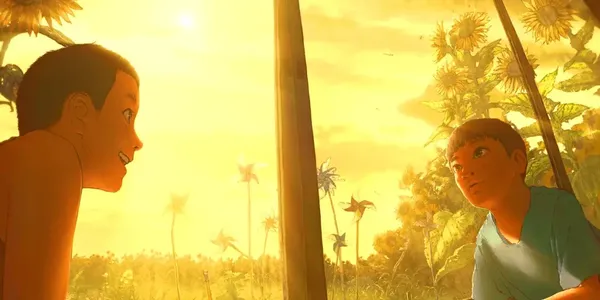

Japanese animator Kohei Kadowaki’s debut feature We Are Aliens is a heart-wrenching look at growing pains that harden into chronic afflictions, and at the fickleness of memory. It understands how experiences shared between people are not always remembered with equal force: what becomes life-altering for one person may become, for another, something half-forgotten.
Early on, Kadowaki takes us into a primary school classroom where students talk about their dreams. One after another, the boys say they want to become soccer players. When it is Tsubasa’s turn, he says he likes nothing. When Gyotaro answers, he misunderstands the question as being about favorite food and says fried rice. It is the kind of small faux pas that happens at an age when school can be either heaven or hell, and the kind of moment one might cringe about every few years, unless it grows into something more haunting.

The two boys form a friendship, though Kadowaki never sentimentalises it. Gyotaro’s intense attention to detail and peculiarities meet Tsubasa’s drifting ambivalence, and for a while We Are Aliens seems to be moving within a familiar coming-of-age register. They exchange advice on the best way to eat curry, engage in odd experiments with the world around them, and invent childish superstitions, such as having to walk strangely through a tunnel or risk dying. But as Gyotaro lowers his guard, Tsubasa begins to see him as an alien, especially after Gyotaro briefly performs that identity himself. What begins as a child’s irrational fear gradually mutates into something more sinister.
The rupture between them is almost banal in its cause. Walking home in the rain, Gyotaro breaks Tsubasa’s umbrella, which belongs to his mother. Tsubasa is grounded, and his mother sells his gaming console. From there, resentment curdles into distance, and distance into cruelty. Tsubasa becomes one of the cool kids who bully Gyotaro.
Told through two points of view, We Are Aliens becomes less a simple story of bullying than a study of how deviation from the 'normal' is treated as alien. More tenderly, it suggests that we are also aliens to our own past selves, to the children we once were, and to memories that no longer belong to everyone in the same way. The film refuses the comforting sheen of the underdog narrative, where the bullied child grows up, thrives and proves everyone wrong. Its view of damage is more stubborn and less flattering.
Kadowaki’s animation relies heavily on rotoscoping, a technique in which animators trace over live-action footage frame by frame to preserve realistic movement and physicality. Yet We Are Aliens never feels mechanically copied from reality. The characters are still distinctly hand-drawn, and the sheer attention to detail in their expressions, gestures and environments is astounding. Small movements – the awkwardness of a child shrinking into himself, the hesitation before speaking, the forced confidence of fitting in – gain an almost painful realism through the technique. The result is an uncanny visual texture that hovers between naturalism and psychological distortion, mirroring the instability of memory itself. At one point, a reference to Vincent van Gogh further amplifies the sense of isolation and spiraling mental anguish brought on by solitude and obsessive dwelling on the past.
At little under two hours, We Are Aliens does feel overextended. Yet its emotional intelligence is difficult to dismiss. Kadowaki has made an animated début about childhood not as innocence lost, but as something that can keep hurting long after everyone else has moved on.
Reviewed on: 15 May 2026


